
Vaccinating against Contagion

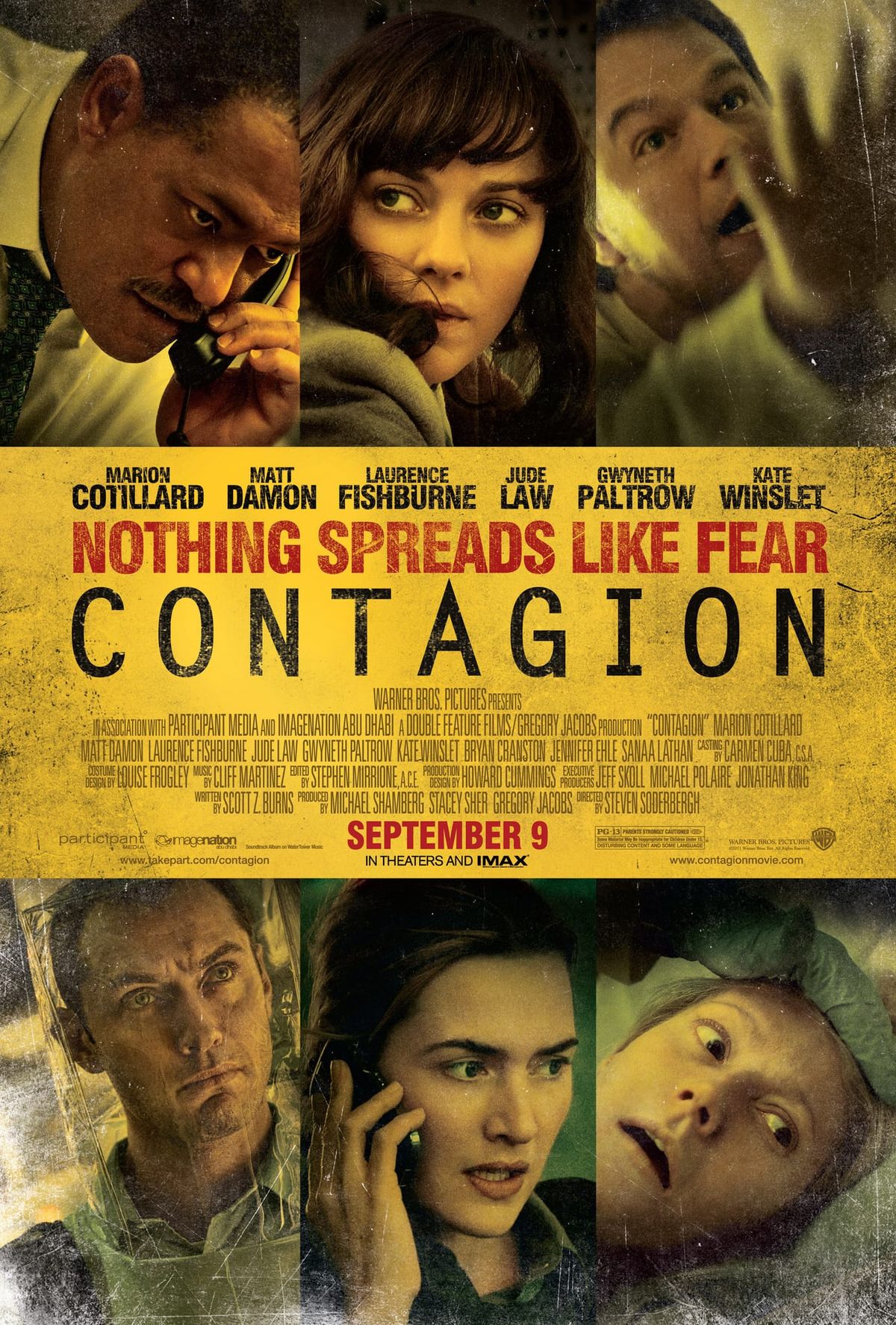
A few weeks ago, my husband and I were perusing HBO in search of a movie to watch. As we scrolled through our options, 2011’s Contagion was prominently featured as one of the most popular movies on the platform and my husband joked we could watch that instead of something new. I knew he wasn’t serious, but I’m always down to watch Contagion. Ultimately, we settled on something else (I think it was They Will Kill You?) but I realized it was past time to discuss my favorite, and arguably the best, pandemic movie made to date. To my delight, we did watch it at a later date to refresh my memory for writing this review.
The first time I watched Contagion I was terrified. Partially because even though I knew it was a straightforward everyone-dies-from-the-virus movie I was still expecting one of the corpses to sit up and try to eat someone, but mostly because the film was so viscerally real. Gwyneth Paltrow (Beth) returns home to the Midwest after a trip to Hong Kong and within two days seizes and dies. Her son dies soon after that alongside other people in London, Hong Kong, and Chicago. The movie follows Beth’s husband, Mitch (played by Matt Damon), his daughter, and CDC and World Health Organization officials – including the military, researchers, and epidemiologists – as they cope with and work to mitigate the novel virus: Meningo Encephalitis Virus 1 (MEV-1). Their stories play out across a backdrop of social distancing, panic buying and looting, conspiracy theories, and mass death. Sound familiar? It’s not surprising that this movie experienced a wave of popularity during the SARS-CoV-2 pandemic.
Contagion was inspired by real-life disease outbreaks such as the 2009 H1N1 pandemic and the first SARS outbreak in the early 2000s. The script was developed in consultation with experts from the WHO, epidemiologists, and researchers so it’s no wonder that the plot is disturbingly real and lauded by infectious disease experts (me included) for its scientific accuracy. Anyone who works in infectious diseases will tell you, it’s not a matter of if, it’s a matter of when. Besides, what’s not to love about a movie that includes an epidemiologist portrayed by Kate Winslet describing the importance of fomites for viral spread?
Having now lived through an actual pandemic, it’s easier than ever to credit the movie with what it got right and where it fell short. For example, the conspiracy theorist in the movie feels positively quaint by real-life standards. Conversely, the movie was dinged at the time for how exceptionally quickly a vaccine was developed whereas now we have the technology to develop vaccines faster than ever. It was shockingly hard to find a written timeline of the events of Contagion, especially since the movie explicitly tracks the events over time, but after skipping through scenes, a viable vaccine is discovered on or shortly after day 29 by Dr. Ally Hextall. The movie then skips forward to day 131 following a montage of testing, FDA approval, manufacture, and distribution. To manage gradual rollout due to limited vaccine stocks, a lottery based on birthday is held on day 133. Gradually, we see life return to normal as the vaccinated population increases.
Don’t get me wrong, 29 days is fast. Especially since we never definitively learn what vaccine platform is used. It’s mentioned early in the movie that killed virus vaccines failed to protect the animal test subjects, even when administered with adjuvant (compounds that stimulate the immune system to increase vaccine efficacy) and the next trial would use live-attenuated vaccines (live virus that’s been modified so it can’t replicate and is therefore not infectious). I assume the final vaccine was live-attenuated since we see it being administered through the nose which is a common technique for live-attenuated vaccines against respiratory viruses, such as the FluMist flu vaccine. ~29 days to create a live attenuated vaccine is pretty crazy given that to do so the virus first must be grown to sufficient quantities and then manipulated to prevent replication prior to testing. However, we now have other vaccine platforms that can be used to develop these prophylactics significantly faster, namely mRNA.
mRNA vaccines are one of the greatest medical advances of the last century. Contrary to popular belief, this technology has been under investigation for decades. The first in vivo study of mRNA vaccines was conducted in 1990 in mice with promising results. Six years ago, investment in this technology paid off in a big way with its successful deployment in the clinic during the SARS-CoV-2 pandemic. Research into mRNA vaccines continues through today.
The principle behind mRNA vaccines is very simple and relies on the central dogma of molecular biology: DNA is transcribed into RNA which in turn is translated into protein that is recognized by the immune system. mRNA vaccines can be produced more rapidly, at larger scale, without biocontainment requirements, and more cheaply than other platforms that require cell, bacterial, or other systems for growth. mRNA vaccines are also useful when vaccinating against complicated antigens that are difficult to synthesize in laboratory systems. Historically, these challenges have limited which antigens may be targeted by vaccination; mRNA vaccines circumvent these difficulties to widen the scope of available antigenic targets. Since only the genetic sequence of the desired antigen is required to begin production of the mRNA, these vaccines can be produced much more quickly than other platforms. This rapid production was observed in real time during the SARS-CoV-2 pandemic; only 66 days after the SARS-CoV-2 spike sequence was published Moderna had vaccinated their first phase I clinical trial participants. While this isn’t quite as speedy as 29 days, given that was the first wide-scale, infectious disease mRNA vaccine produced, 66 days is an unbelievable record. It’s entirely possible that this record could be broken in the future as the technology becomes more streamlined and available. Invigorated by the success of COVID-19 vaccines, mRNA vaccines for other diseases, such as influenza and even cancer, have also made their way into clinical trials.
I have a particular soft spot for mRNA vaccines since they were my area of study in grad school (a lot of the previous paragraph was adapted from my dissertation). It’s impossible to talk about this subject without also acknowledging the political climate that has resulted in widespread skepticism and defunding of further research into this technology. It breaks my heart that such life-saving science is being withheld by people who lack expertise in it. That’s not to say these vaccines are 100% effective with no side effects, no medical technology is, but to sow mistrust and limit access to them is to endanger billions of lives.
Imagine how the events of Contagion may have unfurled if mRNA vaccines had been an option. In the timeline of the movie, vaccine development is delayed because it takes around 12 days to figure out how to grow the virus, never mind the additional time needed to transform virus stocks into viable vaccine. In contrast, MEV-1 was sequenced sometime between days 5 and 8 of the movie so mRNA vaccine synthesis could have begun within the first week of the outbreak. The difference between 8 and 12 days may seem negligible, but as the number of infected people grows exponentially, every second counts. Yes, I’m arguing about the importance of a hypothetical vaccine to a fictitious virus, but we’ve already seen these events play out in real life. I’d rather discuss the implications of mRNA vaccines on a well-researched film than wait for another life-threatening infectious disease to emerge and hope that we’re able to effectively combat it.