Common Cold 3000

Why we haven’t cured the common cold
Futurama “Cold Warriors” Review Part I
After watching The Last of Us for nine weeks I’ve decided I could use a palate cleanser. Something lighthearted that gives my psyche a break before I return to zombie and zombie-adjacent media, and the choice for what to review next that would achieve this goal was obvious: Futurama.
Futurama is probably my favorite show; I’ve lost count of the number of times I’ve watched it. The show follows Philip J. Fry, a man who is cryogenically frozen in the year 2000 and wakes up in the year 3000. Futurama parodies many science fiction stories and ideas, but is also known for its scientific accuracy. Between them, the writers for Futurama held three PhDs and seven masters degrees, allowing them to stretch the limits of fact and fiction in every episode1.
The most famous example of this is the “Futurama Theorem”, created by writer Ken Keeler, who holds a PhD in Mathematics. This theorem was created for season 6, episode 10, “The Prisoner of Benda”, in which a pair of characters swap minds but are unable to return to their bodies because no pair can swap more than once. As more and more characters exchange minds, the theorem finds that in order for everyone to return to their original bodies only two additional individuals who have not swapped with anyone are needed2.
I love the entire series and Futurama has a lot of content to mine, but for brevity’s sake and because the purpose of this is to review pop culture infectious diseases,
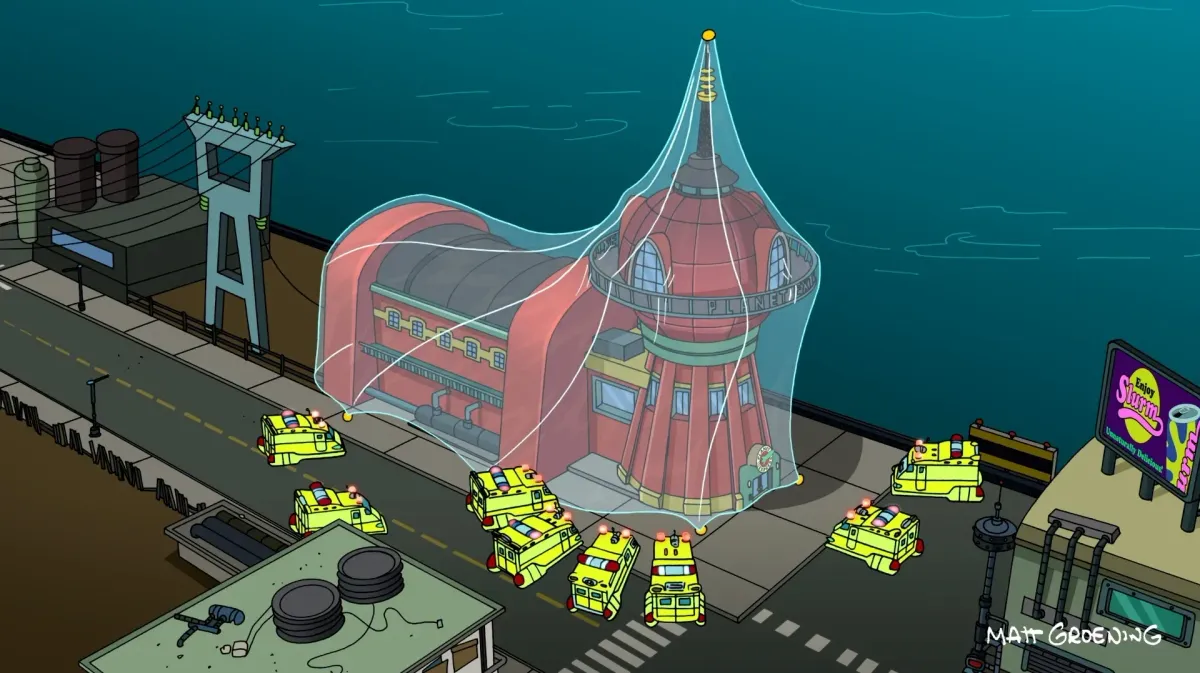
I’m going to focus on just one episode: “Cold Warriors” (season 6, episode 24; season 8, episode 11 on Hulu). In the year 3000 the common cold has been eradicated, but Fry, having been transported from a time before a cure for the cold existed, accidentally reintroduces it. The characters are quarantined to prevent the cold from spreading to the rest of the vulnerable population, but Bender, a robot who therefore cannot become infected, leaves the quarantine after being sneezed on. As the virus ravages Manhattan, the characters scramble to make a vaccine before the city is launched into the sun. It’s a really fun episode and I recommend watching it (or the whole series which is currently streaming on Hulu). Ultimately, Dr. Farnsworth successfully creates a vaccine, but as it stands in 2023, we don’t have a cure or vaccine for colds and finding one is a long way off.
The common cold is a general name for respiratory disease caused by over 200 different viruses3 including rhinoviruses, parainfluenza viruses (these are distinct from influenza viruses responsible for flu infections), respiratory syncytial virus (RSV), and coronaviruses (viruses related to SARS-CoV-2 but cause much milder disease than COVID-19)4. Rhinoviruses are the culprit in most cold infections, responsible for 30-35% each year3, and within rhinoviruses, there are more than 100 serotypes5. On average, adults will contract a cold 2-3 times per year. This rate is even higher in children, averaging 6-10 colds annually6.
This great diversity within cold-causing viruses helps explain how people can be re-infected so frequently and why we haven’t developed a cure. A serotype is a group within a singe species that has distinct molecules on its surface. This is important because our immune response to infections, particularly antibodies, are often directed toward these surface proteins and this response is pathogen specific. For example, SARS-CoV-2 vaccines train our immune system to recognize the virus’s spike protein, which sits on the surface of the virus7. This vaccine can’t prevent infection from other viruses and loses efficacy as the spike protein acquires mutations8. Therefore, if we were to create a broadly effective vaccine against the common cold, we’d have to engineer it to account for the over 200 viruses that cause this disease and each of their serotypes. No easy feat.
The episode is resolved when Dr. Farnsworth creates a vaccine for the common cold and there are some obvious factors that contribute to this success: 1) it’s a fictional TV show, and 2) it takes place in the year 3000 so Dr. Farnsworth was working with far more advanced technology than we have right now. Even so, if this situation were taking place in real life, failure to create a vaccine is not a foregone conclusion.
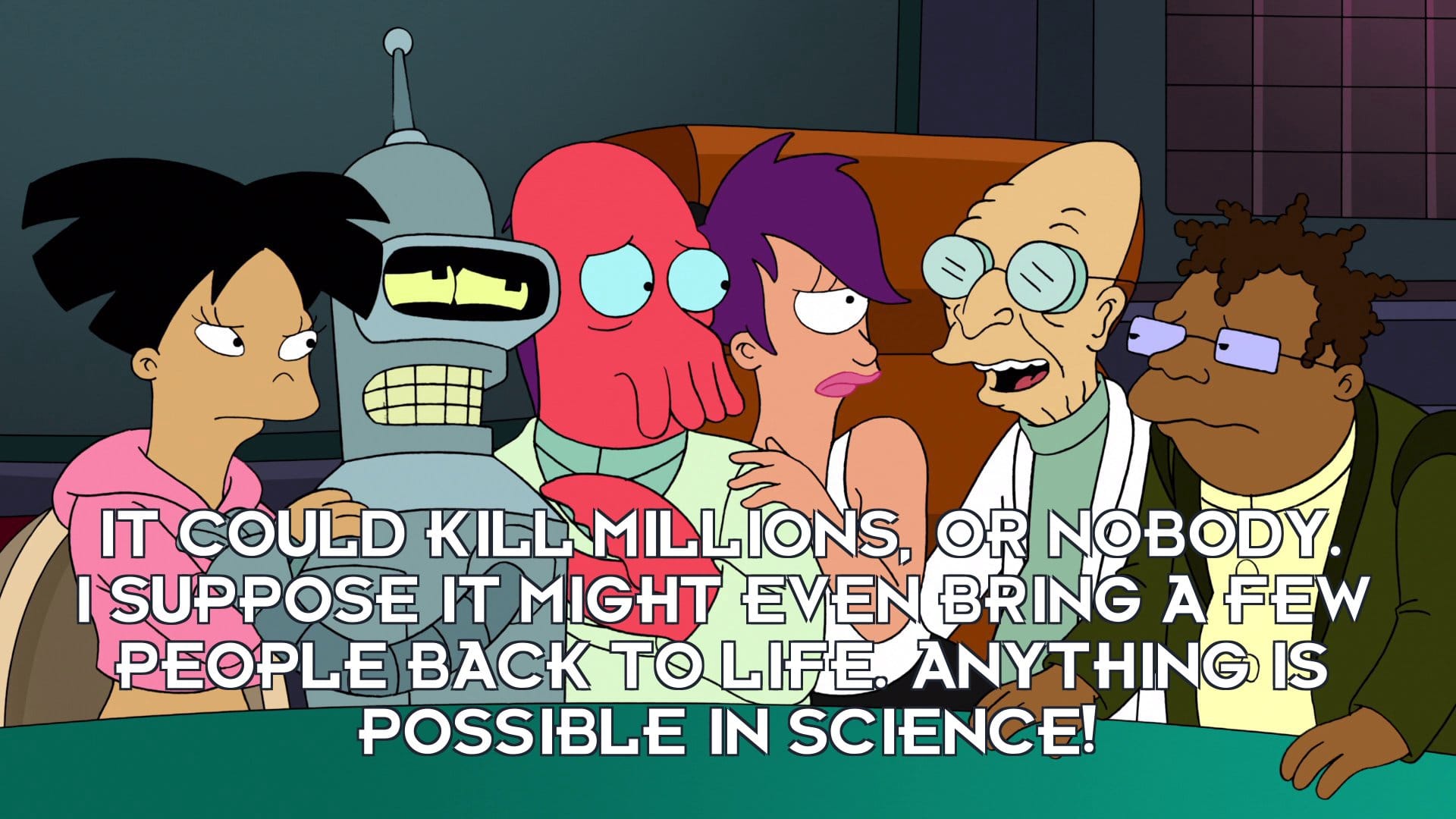
Imagine the world as it exists in this episode: it’s 3000 and the common cold has been eradicated until it is reintroduced by an unwitting person. In this case, a vaccine is needed against only the virus carried by Fry. Creating a vaccine against one virus is significantly easier than trying to synthesize one against 200+ viruses, particularly with the technology available in 3000. The greatest difficulty in making this vaccine lies in matching it to the correct virus. As Dr. Farnsworth says to Fry, “The vaccine requires the original, unmutated 20th century cold virus. So I need to grind you into a paste.”* Fry is saved from this fate when he remembers the winning project from a science fair at his school. The project contains an original cold virus and was launched into space in the late 1980’s where it was preserved in ice on one of Saturn’s moons (seriously, watch the episode). Perhaps the most unbelievable part of the episode, given how many different viruses cause the common cold, is that the virus in the science fair matches the one Fry is infected with. Nevertheless, through the magic of television it does, and Manhattan is saved.
*There are also much better ways to isolate a virus than liquefying a person. A simple nasal swab or respiratory sample would have worked just as well.
In 2023 we have significantly more and higher hurdles to overcome to a common cold vaccine, but strides are being made in vaccinology every day. We may not have a cure for the common cold now, but maybe in 1000 years we will.
My next post will be part II of Futurama “Cold Warriors” on zombie viruses. Not viruses that turn people into zombies, but ancient viruses that are being resurrected from thawing permafrost.
References
1. Verrone PM. “Welcome to the War of Tomorrow” How Futurama’s writers depicted asymmetrical warfare. Slate. https://slate.com/technology/2014/09/futurama-writer-patric-verrone-on-how-the-cartoon-depicted-asymmetrical-warfare.html. Published 2014. Updated 9/21/2024. Accessed 3/20/2023, 2023.
2. The Prisoner of Benda. Wikipedia. https://en.wikipedia.org/wiki/The_Prisoner_of_Benda. Updated 12/23/2022. Accessed 3/20/2023, 2023.
3. Wein H. Understanding a Common Cold Virus. National Institutes of Health. NIH Research Matters Web site. https://www.nih.gov/news-events/nih-research-matters/understanding-common-cold-virus#:~:text=An%20estimated%2030%2D35%25%20of,colds%20are%20caused%20by%20rhinoviruses. Published 2009. Updated 4/13/2009. Accessed 3/27/2023, 2023.
4. Common Colds: Protect Yourself and Others. Centers for Disease Control and Prevention. https://www.cdc.gov/features/rhinoviruses/index.html. Published 2021. Updated 11/29/2021. Accessed 3/27/2023, 2023.
5. Andrup L, Krogfelt KA, Hansen KS, Madsen AM. Transmission route of rhinovirus - the causative agent for common cold. A systematic review. Am J Infect Control. 2022.
6. Common colds: Overview. Cologne, Germany: Institute for Quality and Efficiency in Health Care; 2006.
7. Martínez-Flores D, Zepeda-Cervantes J, Cruz-Reséndiz A, Aguirre-Sampieri S, Sampieri A, Vaca L. SARS-CoV-2 Vaccines Based on the Spike Glycoprotein and Implications of New Viral Variants. Front Immunol. 2021;12:701501.
8. Chi WY, Li YD, Huang HC, et al. COVID-19 vaccine update: vaccine effectiveness, SARS-CoV-2 variants, boosters, adverse effects, and immune correlates of protection. J Biomed Sci. 2022;29(1):82.