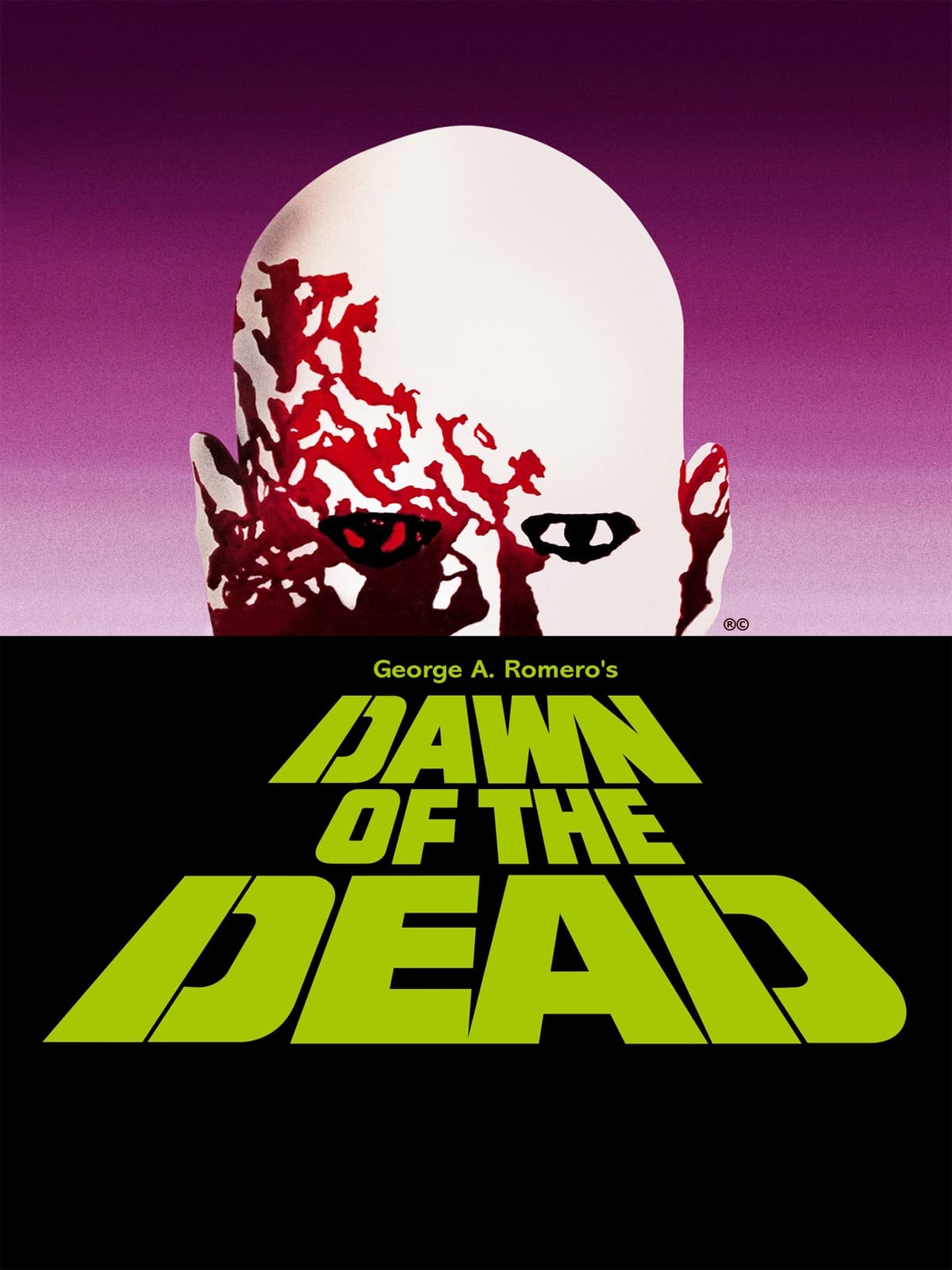
Dawn of the Dead (1978)

**Spoilers below**
After taking a quick detour with Warm Bodies, I returned to the George Romero zombie-verse with Dawn of the Dead. Online reviews tell me all of the movies in the Dead series are bangers and so far I have to agree. Dawn of the Dead is a direct sequel to Night of the Living Dead. We find out that the initial outbreak wasn’t squashed as implied at the end of Night; rather, the situation has escalated with more and more walking corpses terrorizing the living.
The movie opens in a television newsroom that is in chaos as it continues to broadcast information on the crisis and advises survivors to flee to rescue centers. A traffic reporter, Stephen, and a producer, Fran, plan to steal a helicopter from the station and flee the deteriorating situation. As they reach the helicopter they are joined by two SWAT officers, Roger and Peter, who join their escape. Once in the air, they realize they have no place to go and ultimately land at a mall. The rest of the movie follows them clearing the mall of zombies and shoring up the entrances. Drama is derived from learning that Fran is pregnant and Roger getting bitten and reanimating. The movie comes to a head when a biker gang breaks into the mall, letting in a swarm of zombies. Between the zombies and human conflict, Stephen dies alongside the bikers. Peter and Fran escape in the helicopter to an unknown future.
This movie isn’t meant to be a comedy, and I’m sure when it premiered in 1978 it delivered scares and tension galore, but as a viewer in 2025…it was really funny. Between coating the actors playing the zombies in blue makeup, making them look like freshly chalked pool cues, and the circus-esque music that was tonally discordant from the events unfolding on screen, everything about the film was comical. Honestly, I loved it. Confining a group of survivors to a mall is a great premise. A chunk of the movie is just them living it up as they enjoy every resource they could possibly want at the tips of their fingers and then some. It made me sad that mall culture has largely died because I can’t imagine a better place to ride out the apocalypse.
As a sequel to Night of the Living Dead, we don’t get much new information about the zombies that wasn’t already established. There’s a single throwaway line indicating that scientists now believe zombie-ism is caused by a virus, rather than the space radiation described in Night. The only other new feature of the outbreak is that the zombies persist because people are reluctant to kill them. We’re shown multiple news clips in which a scientist reminds viewers that while the undead may look like their friends and family, they are now mindless, soulless, undead cannibals with no remaining humanity. He emphatically repeats that the only way the outbreak will be brought under control is by mercilessly killing the zombies.
Zombies are most often treated in media as fodder for gory action scenes or jump scares. Dawn continually reminds the viewer that zombies are monstrous beings that used to be someone’s loved ones. Even if you intellectually knew that nothing of your spouse, child, parent, etc. remained, would you be able to pull the trigger? My kneejerk reaction is to say that I would. Zombies terrify me and it’s easy to say, in a world where I’m not actually being confronted with this question, that I would take no prisoners. But if I was staring down one of the people I loved most in the world, even knowing that it wasn’t really them anymore, I don’t know if I could do it. It’s hard to blame the people in Dawn for their choices not to permanently kill the ones they love.
Since zombies aren’t real, we have no data on the willingness of people to kill them. One of the closest analogies I can think of is “pulling the plug” or discontinuing life support. There are obvious differences in this analogy. People on life support are still alive, not reanimated corpses, and pose no imminent threat to those around them. If they were to wake up, it’s assumed and hoped that they would retain their personalities and thought processes. According to an article in the American Journal of Medicine, discontinuing life support is done when a severely injured or ill patient is highly unlikely to survive and requires both the medical team and family to understand and accept that efforts to keep the patient alive are both futile and not in the patient’s best interest. In 2009, social psychologist Professor Sheena Iyengar of Columbia University published a qualitative study that analyzed interviews with parents who chose to remove their infants from life support. They found that these parents struggled with negative emotions (guilt, doubt, depression, anger, etc.) after making the decision. Some felt personally responsible for their child’s death while others felt that they had made the inevitable choice. The researchers also found that parents that had received recommendations from medical professionals to remove the infant from life support coped better than those who had made the decision independently, though some individuals felt it should be their decision and theirs alone, rejecting the idea that doctors should be involved in such a personal and consequential choice. None of the parents made this decision lightly and all were impacted by the loss of their child; it is unsurprising that the way individuals respond to their unique circumstances is deeply personal and variable.
Perhaps a better proxy for killing zombies is killing another person in self-defense. After all, even though zombies wear the skin of a loved one, at the end of the day they will try to eat you. A 2014 study evaluated the relationship between killing or seriously injuring someone and mental health in 400 police officers. The researchers found that 68.8% of participants felt they were exposed to at least one event in which their life was threatened during the study period and 9.8% reported having to kill or seriously injure someone while performing their job. After controlling for other demographic variables, their analyses found that killing or injuring someone in the line of duty was associated PTSD symptoms. I have to imagine that these symptoms would be exacerbated if the person in question who was killed was a friend or family member.
I’m very grateful to have never gone through either experience, just as I’m very grateful to live in a world without zombies. Even though their humanity is gone, what would it do to ours to have to exterminate the people we love?