It lives!

Futurama “Cold Warriors” Review Part II
In my last post I reviewed season 6 episode 24 of Futurama, “Cold Warriors”, in which the cold virus is transported to the year 3000 via the main character who was cryogenically frozen in 2000. Because the cold has been eradicated from the future the characters must create a vaccine before Manhattan is launched into the sun to prevent the virus from causing a pandemic. I’m once again going to recommend watching the episode (or the whole series); it’s currently streaming on Hulu.
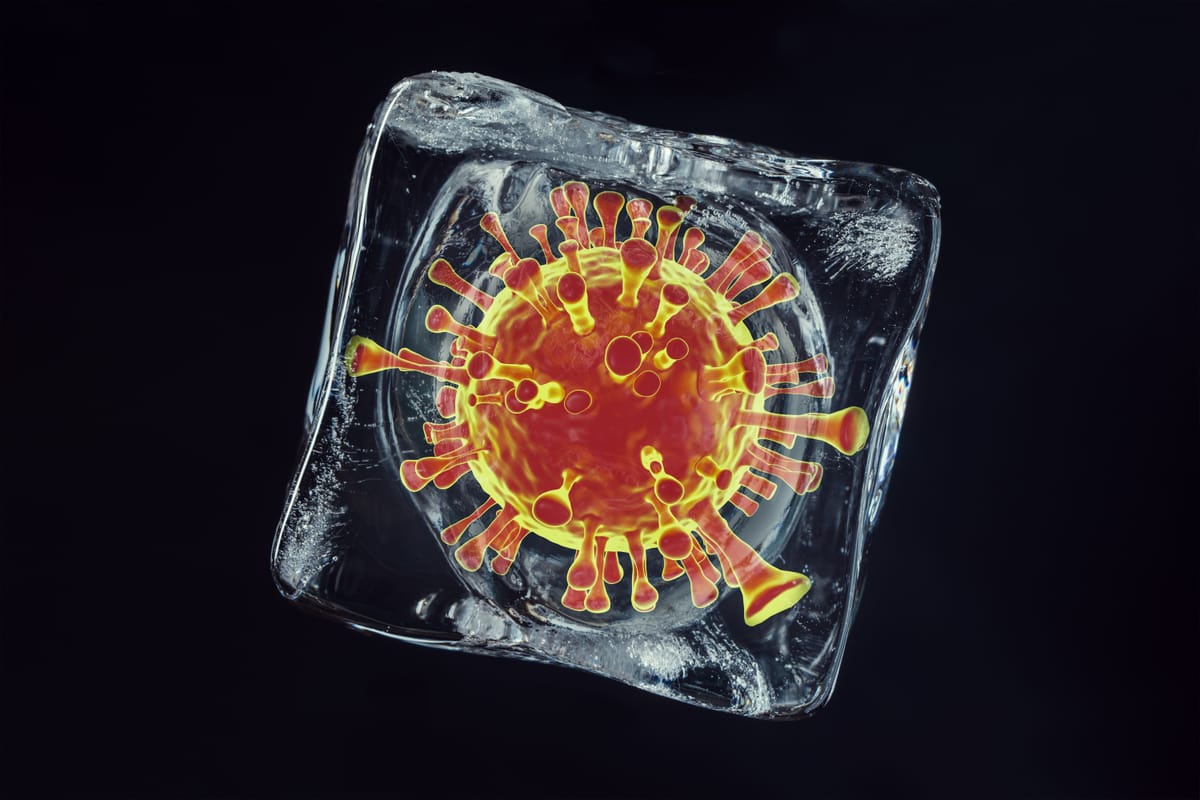
While the focus of my last post was on the difficulties we currently face in making a vaccine for the common cold, and why it was scientifically feasible in the episode, in this post I want to backtrack to the central conceit of the plot: an extinct virus is resurrected from deep-freeze with the potential to cause widespread death and disease. This may sound like a fun bit of sci-fi, but resurrected viruses, or zombie viruses, are real. As climate change causes previously frozen areas to thaw there is a real possibility that ancient pathogens may emerge. In fact, we’ve already found some.
In 1997 the genetic sequence of the 1918 “Spanish” influenza pandemic virus was first published1. Though at least 50 million people died during this pandemic, scientists and clinicians were unable to identify the disease-causing microbe at the time. Fifteen years later the first influenza virus was isolated and identified but due to limitations of the available technology, the virological and host factors that influenced the severity of the 1918 pandemic remained unknown. And so, the 1918 pandemic virus remained a mystery in the field of influenza virology throughout the 20th century2. That is, until molecular biology and genetic sequencing techniques evolved that allowed small fragments of viral genetic material to be copied and sequenced. Using preserved tissue samples from the National Tissue Repository of the Armed Forces Institute of Pathology, as well as lung samples taken from a body preserved by permafrost in Alaska, researchers were able to fully reconstruct the 1918 pandemic influenza virus over 9 years3.
This was the first instance the resurrection of a zombie virus and was a feat of molecular biology and virology. In reconstructing this virus, many questions regarding the 1918 pandemic have been answered. Additionally, understanding the 1918 pandemic influenza virus has provided insight into virological factors and adaptations that influence disease severity, influenza virus evolution, and host preference and spread. Notably, characterizing this virus also helped direct public health policy during the 2009 H1N1 influenza pandemic. After sequencing the 2009 virus, researchers found that the key influenza protein the immune response recognizes (hemagglutinin, or HA) was descended from the 1918 virus2. Because of the similarity between the 2009 and 1918 HA proteins, elderly people who had been exposed to 1918-like influenza viruses in the past retained some immunity that also helped protect them from the 2009 virus4. Therefore, vaccines against the 2009 influenza virus were initially given to younger individuals without such immunity who were most at risk2. However, despite the knowledge gained by characterizing the 1918 influenza virus, its resurrection also led to ethical questions surrounding the risks associated with reviving such a dangerous pandemic virus5.
In 2012, detection of DNA fragments from the variola virus (the causative agent of smallpox) was published in the New England Journal of Medicine. Archeological sites in Siberia were found to contain wooden graves preserved in permafrost, one of which had five mummies. These graves were dated to the 17th or 18th century. Samples taken from mummy 2 revealed tissue damage consistent with a sudden and lethal infection. Isolation and sequencing of viral DNA fragments from these samples found that they were related to contemporary variola viruses, suggesting modern smallpox viruses descended from the frozen virus6. As far as I know, no efforts to reconstruct this virus have been made. In 1980 the World Health Organization declared smallpox eradicated after over 10 years of concerted surveillance and immunization efforts across the world7, so it’s probably best to leave this one in the grave.
More recently, 13 viruses were resurrected from permafrost in Siberia. The researchers specifically targeted viruses that infect Acanthamoeba, a species of amoeba, in their search because they are commonly found throughout the environment. One virus was isolated from woolly mammoth remains that were dated as over 27,000 years old. Remarkably, the oldest virus that was isolated was nearly 48,500 years old and remained infectious when cultured with amoebas8.
A huge diversity of microbes lay dormant across vast areas of the arctic, trapped in the statis of permafrost. Currently, because much of this area is still frozen and because so few people live in the arctic, the risk of a zombie virus jumping into humans and causing a public health catastrophe is low. However, as the earth continues to warm and as people migrate north in response to climate change this risk increases. Could an extinct virus with pandemic potential be resurrected from deep-freeze as in Futurama’s “Cold Warriors” episode? Probably not right now, but maybe in the future.
References
1. Taubenberger JK, Reid AH, Krafft AE, Bijwaard KE, Fanning TG. Initial genetic characterization of the 1918 "Spanish" influenza virus. Science. 1997;275(5307):1793-1796.
2. Taubenberger JK, Baltimore D, Doherty PC, et al. Reconstruction of the 1918 influenza virus: unexpected rewards from the past. mBio. 2012;3(5).
3. Taubenberger JK, Hultin JV, Morens DM. Discovery and characterization of the 1918 pandemic influenza virus in historical context. Antivir Ther. 2007;12(4 Pt B):581-591.
4. Yu X, Tsibane T, McGraw PA, et al. Neutralizing antibodies derived from the B cells of 1918 influenza pandemic survivors. Nature. 2008;455(7212):532-536.
5. The 1918 flu virus is resurrected. Nature. 2005;437(7060):794-795.
6. Biagini P, Thèves C, Balaresque P, et al. Variola virus in a 300-year-old Siberian mummy. N Engl J Med. 2012;367(21):2057-2059.
7. Smallpox. World Health Organization. https://www.who.int/health-topics/smallpox#tab=tab_1. Published 2023. Accessed 4/10/2023, 2023.
8. Alempic JM, Lartigue A, Goncharov AE, et al. An Update on Eukaryotic Viruses Revived from Ancient Permafrost. Viruses. 2023;15(2).