It’s Why She’s Immune

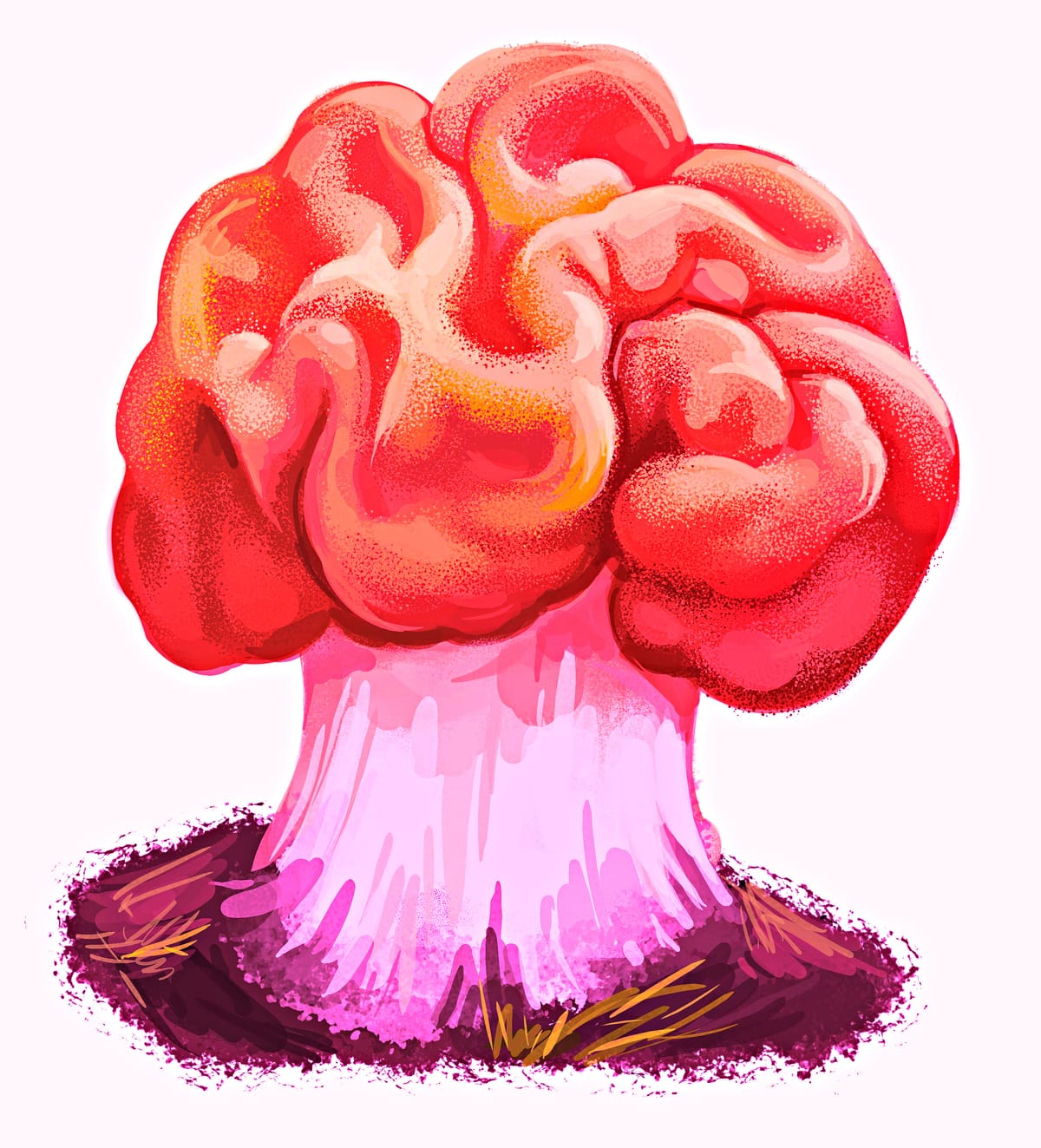
A dissection of Ellie’s immunity in the season one finale of The Last of Us
***Spoilers for the season one finale of HBO’s The Last of Us***
I had planned for “There is No Cure” to be my last post about The Last of Us, but after watching the season finale I can’t help but revisit cordyceps and the explanation for Ellie’s immunity.
Episode nine opens with a heavily pregnant woman* running from unseen pursuer. She reaches an empty farmhouse where she locks the doors and barricades herself in a room upstairs. It’s clear that she is in labor as she prepares to defend herself. I didn’t really watch the next part but when I opened my eyes, she had killed an infected while delivering her baby. However, she had also been bitten in the struggle. Noticing the bite on her leg she quickly cuts the umbilical cord, soothing the baby, who she names Ellie.
*The woman is played by Ashley Johnson, the original voice of Ellie in the game.
Later that night, Marlene, last seen in episode one, returns to the farmhouse where she finds the woman, Anna, holding Ellie and fighting the infection. Anna begs Marlene to take Ellie and shoot her before she can turn. It’s obvious that Anna is running out of time. Marlene eventually relents and does as Anna asks.
Could Ellie have become infected through the umbilical cord?
I’ll admit, both my husband and I rolled our eyes a bit at the implications of this scene. It’s true that infections can be passed from mother to baby during pregnancy. Common infections are summarized in the acronym TORCH for Toxoplasma gondii, other agents such as syphilis and chicken pox, Rubella, Cytomegalovirus (CMV), and Herpes1. None of these pathogens are fungi, and serious fungal infections during pregnancy are rare. Of prenatal fungal infections, most are caused by Candida species, which can result in low birth weight or fetal infection if they enter the amniotic cavity1.
Given how infectious cordyceps is in The Last of Us, it's certainly possible that it could be passed from mother to baby. However, there is at most only a couple of minutes in between when Anna is bitten and when she cuts the umbilical cord. Even though The Last of Us has established that the course of cordyceps infection is unusually rapid, this is a bit of stretch and I struggled to suspend my disbelief enough to accept that Ellie could become infected that quickly.
The episode then turns to Salt Lake City, where present-day Ellie and Joel are searching for the Fireflies’ hospital. While wandering through the city, they are ambushed by the Fireflies, knocked out, and taken to the hospital. When Joel wakes up, Marlene greets him. He asks where Ellie is, and she tells him that Ellie is being prepped for surgery. “What surgery?” Joel asks. Marlene tells him, “Our doctor, he thinks that the cordyceps in Ellie has grown with her since birth. It produces a kind of chemical messenger. It makes normal cordyceps think that she’s cordyceps. It’s why she’s immune. He’s going to remove it from her, multiply the cells in the lab, produce those chemical messengers, and then they can give it to everyone. He thinks it could be a cure, Joel. A cure.”
Does this explain Ellie’s immunity?
1. The infection has grown with Ellie since birth.
This is entirely plausible. We are colonized with all kinds of microbes that live in and on us and contribute to our health in a variety of ways, called the microbiome. Each individual forms their microbiome within the first few years of life, but it can change over time in response to medication, the environment, and diet. Generally, these microbes are benign and live with us symbiotically2. However, they can cause opportunistic infections under the right circumstances. Opportunistic infections occur when microbes that don’t normally cause disease have an opportunity to become pathogenic, such as when a host’s immune system is weakened3. Most fungal infections are opportunistic4. Another example of living with pathogens is during latent infections. Latency is a stage of infection in which a pathogen lies inactive and does not cause disease. Varicella zoster, the cause of chicken pox, is a common virus that enters a latent stage and can be reactivated in adulthood to cause shingles5. Pathogenic fungi can also enter latency and be reactivated under the right conditions6.
Based on this and Marlene’s explanation, I suspect that Ellie has a latent cordyceps infection, though it’s not clear how her body is controlling the fungus and preventing it from causing disease. Every other person who has become infected with cordyceps has succumbed to the disease; why hasn’t Ellie?
2. Ellie is infected with cordyceps that produces a chemical messenger
It’s probably a safe guess that the chemical messenger Marlene is referring to has been made up for the purpose of the show; I couldn’t even begin to guess what a possible biological analog might be. Ignoring the specifics of the messenger, effectively what Marlene is saying that Ellie’s cordyceps produces a compound that prevents infection with normal (wildtype) cordyceps. This implies that Ellie’s cordyceps is unique in some way. After all, billions of other people have been infected by cordyceps and succumbed to the disease. Presumably their infections did not produce this messenger, keeping wildtype cordyceps at bay. So, what makes Ellie different?
Alternatively, maybe the messenger is produced during all cordyceps infections. The infected must have some way to sense infected vs. uninfected people and attack them accordingly. Perhaps this messenger is present in all infected and it allows them to recognize others that cordyceps has already colonized. This could make sense as the infected leave each other alone and specifically target uninfected people. But again, if this messenger is present in all infected people, why didn’t Ellie transform into a fungus-riddled monster?
3. The chemical messenger tricks cordyceps into thinking Ellie is already infected
Taking the chemical messenger and its presence in Ellie at face value, how does it ward off wildtype cordyceps? There’s not a lot to draw from in microbiology that will answer this question. I don’t know of any pathogens that produce an antimicrobial that keep variations of themselves away. Microbes will often secrete compounds that kill other microbes, like keanumycins secreted by Pseudomonas to defend against predatory amoebas7 and antibiotics produced by cordyceps to prevent consumption of infected ants by bacteria8,9. That doesn’t mean such a messenger couldn’t exist, but it doesn’t make a lot of evolutionary sense as there are benefits to aggregating for microbial species. For example, bacterial species form biofilms that help them avoid the immune response, antibiotics, and environmental stressors10.
After Marlene tells Joel about Ellie’s procedure he says, “Cordyceps grows inside the brain.” Marlene quietly confirms, “It does.” In this moment, Joel realizes that to create a cure they need Ellie’s brain. They need Ellie’s life. And he can’t let that happen.
Should Joel have let them kill Ellie?
Whether or not Joel should have saved Ellie is a moral gray area. Marlene didn’t give Ellie the choice to be killed, but Joel also didn’t give her the choice to be saved. How do you weigh possibly saving the lives of the last remaining humans against the life of one girl? Ultimately, it should have been Ellie’s choice, but would a traumatized 14-year-old be able to make an informed decision? Everyone will come to their own conclusions, but after watching the finale I think Joel was right to save Ellie. I think he was right because Ellie probably would have sacrificed herself for nothing. Realistically, I don’t believe that a cure is even possible.
1. How is Ellie immune?
The first reason I’m suspicious that they would even be able to make a cure is that they still don’t really know how Ellie is immune. The chemical messenger is just a theory, an untested theory. They haven’t had access to Ellie’s cordyceps to determine if the doctor’s hypothesis is correct, much less use it to make a cure. And, as I’ve already discussed at length, how does the messenger work? Billions of other people have been infected and none of them developed immunity. I think it’s most likely that there is some rare trait inherent to Ellie that’s altered her cordyceps infection. It’s likely a genetic anomaly, but how would the Fireflies ever figure out what specific mutation is linked to her immunity? The best way to do this would be to sequence Ellie’s DNA, but The Human Genome Project, in which the entire human genetic code was sequenced, was only completed in April 2003, the same year as the cordyceps outbreak. How would they sequence her genome and interpret the results when the technology was much less developed and much more inaccessible than it is now? Finding such a mutation would be like looking for one misspelled word in the entire dictionary without knowing how to read.
Or, as the show implies, maybe Ellie is not unique, it’s the circumstances of her infection that are. If another woman were bitten right after giving birth but before the umbilical cord was cut would that baby also be immune? There’s no way to know without performing such a grisly experiment, or at least simulating it in some way. And if the results are different, does that disprove the messenger theory? What if that child is also immune? It’s not difficult to imagine how other groups might use that gruesome knowledge to create a generation of immune children.
2. They don’t have the resources to make a cure
Even if the doctor’s hypothesis was correct and the messenger is the key to Ellie’s immunity, I still doubt they would be able to use it to make a cure. Not to discredit the doctor, but we have no idea what his training was in. I assume he had medical training prior to the outbreak, but it could have been in a completely unrelated field. It’s also been 20 years since he would have last regularly practiced. It’s possible that he's used the last 20 years to study up on mycology and pharmaceutical development, but if he didn’t have research experience in the appropriate fields self-teaching will only get him so far. Treating patients and researching therapeutics both require specialized, but different, skill sets. He’s also only one person. Antimicrobial drug discovery is driven by teams of people with scientific training in different aspects of immunology, pharmacology, and microbiology. It’s not impossible that one person could develop a cure, but that undertaking is much greater and much less likely to succeed.
The doctor is also battling a lack of technology. Scientific advancement effectively stopped in 2003, leaving the doctor with only the tools available at that time and putting him at a significant disadvantage compared to today. In 2003 no one, including mycologists like Dr. Ratna, thought cordyceps could infect humans and societal collapse happened so quickly that it’s doubtful any useful knowledge of human infection was gathered.
3. Even if they make a cure, would it work?
If the doctor was able to make a cure against the odds there is still no guarantee it would work at scale. Humans differ greatly from person to person and it’s difficult to predict how effective and safe a therapeutic will be across individuals. That’s why clinical trials are essential to ensure safety and efficacy of new drugs, starting with small groups of people and moving up to thousands of individuals over multiple years before the drug becomes licensed and widely available11. The messenger may be effective in people other than Ellie, but it also may not. Besides, the world is still populated with infected and as Tess says to Ellie in episode two, “You’re not immune from being ripped apart.”
If the cure is successful, it must still be distributed to the remaining population. The United States is overrun with infected, and any remaining humans are scattered. There’s no supply chain and, as we’ve seen from Joel and Ellie’s journey, trekking across the country comes with a significant risk of attack by infected or raiders. It’s not an impossible task, but it’s a highly improbable one.
All of this probably sounds like I didn’t enjoy the final episode of The Last of Us. I actually loved it and have loved the entire season. My critiques are based in real-life science because I live in real-life. Ultimately, it doesn’t matter what reality-based science says because The Last of Us isn’t my reality. Maybe in the world of The Last of Us the chemical messenger does explain Ellie’s immunity and maybe the doctor could have made a cure. Or maybe it doesn’t and he couldn’t. That’s the fun of The Last of Us and other fictional outbreaks; watching them and asking, "What if?”
References
1. Kumar M, Saadaoui M, Al Khodor S. Infections and Pregnancy: Effects on Maternal and Child Health. Front Cell Infect Microbiol. 2022;12:873253.
2. Microbiome. National Institute of Environmental Health Sciences. https://www.niehs.nih.gov/health/topics/science/microbiome/index.cfm#:~:text=The%20microbiome%20is%20the%20collection,to%20human%20health%20and%20wellness. Published 2023. Updated 2/22/2023. Accessed 3/13/2023, 2023.
3. Faria R, Pereira C, Alves R, Mendonça T, Farinha F, Vasconcelos C. Chapter 15 - Opportunistic Infections and Autoimmune Diseases. In: Shoenfeld Y, Agmon-Levin N, Rose NR, eds. Infection and Autoimmunity (Second Edition). Amsterdam: Academic Press; 2015:251-277.
4. Rokas A. Evolution of the human pathogenic lifestyle in fungi. Nat Microbiol. 2022;7(5):607-619.
5. Traylen CM, Patel HR, Fondaw W, et al. Virus reactivation: a panoramic view in human infections. Future Virol. 2011;6(4):451-463.
6. Brunet K, Alanio A, Lortholary O, Rammaert B. Reactivation of dormant/latent fungal infection. J Infect. 2018;77(6):463-468.
7. Götze S, Vij R, Burow K, et al. Ecological Niche-Inspired Genome Mining Leads to the Discovery of Crop-Protecting Nonribosomal Lipopeptides Featuring a Transient Amino Acid Building Block. Journal of the American Chemical Society. 2023;145(4):2342-2353.
8. Amnuaykanjanasin A, Panchanawaporn S, Chutrakul C, Tanticharoen M. Genes differentially expressed under naphthoquinone-producing conditions in the entomopathogenic fungus Ophiocordyceps unilateralis. Can J Microbiol. 2011;57(8):680-692.
9. Wichadakul D, Kobmoo N, Ingsriswang S, et al. Insights from the genome of Ophiocordyceps polyrhachis-furcata to pathogenicity and host specificity in insect fungi. BMC Genomics. 2015;16:881.
10. Vestby LK, Grønseth T, Simm R, Nesse LL. Bacterial Biofilm and its Role in the Pathogenesis of Disease. Antibiotics (Basel). 2020;9(2).
11. Step 3: Clinical Research. U. S. Food & Drug Administration. https://www.fda.gov/patients/drug-development-process/step-3-clinical-research. Published 2018. Updated 1/04/2018. Accessed 3/14/2023, 2023.