Night of the Living Dead (1968)

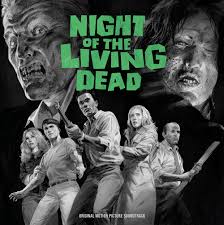
**This movie is 57 years old, but just in case, spoilers below**
It seemed fitting to start my zombie desensitization with the genesis of the subgenre as we know it: George A. Romero’s Night of the Living Dead. Not only is this movie the progenitor of modern zombie lore, but it seemed like a safe choice for my squeamishness due to the lack of contemporary special effects; I also love a classic black and white film.
The movie opens with a car winding down a deserted country road set to an ominous score as brother and sister duo Johnny and Barbra travel to a cemetery to visit their father’s grave. As they arrive at the cemetery and get out of the car, they hear the beginning of a news bulletin on the radio, and in classic horror movie fashion, turn it off before they can learn about the danger that’s about to befall them. In a darkly hilarious scene, Johnny teases Barbra about being spooked by the cemetery by extending his arms and limping around while moaning, “They’re coming to get you Barbraaaa,” as an actual zombie shambles around behind him. Johnny is predictably dispatched by the zombie and Barbra flees to a nearby farmhouse where she finds the mangled corpse of the owner who was mauled by the undead.
Shortly after Barbra takes refuge, she is joined by Ben, who has fought his way through the growing horde of zombies surrounding the house. Together, they board up the doors and windows. As the film progresses, they find other people hiding in the cellar – a family (Harry and Helen) with a young daughter (Karen) who’s been injured and a young couple (Tom and Judy). Tensions rise as they argue over the best way to stay safe while receiving updates about the escalating situation from the home’s radio and television. Through these news blasts they learn that there’s a rescue center nearby that can provide medical care for Karen. They devise a plan to fuel up an available truck outside, and in executing the plan Tom and Judy are killed when the truck explodes. There are few depictions of the zombies consuming human flesh throughout the film, but the movie does linger on them going to town on the barbecued couple. It’s pretty apparent that the human remains were made out of foods like chicken drumsticks, but the actors portraying the zombies really sell the mindlessly ravenous behavior you’d expect.
Tensions continue to rise while the undead mass grows outside until they eventually break down the doors and windows of the home. Ben accidentally shoots Harry who staggers down the stairs to the cellar and dies next to Karen. Karen, whose injury turns out to be a zombie bite, dies and is resurrected after which she begins eating her father. Helen finds her chowing down in the cellar before Karen kills Helen with a trowel. Upstairs, Barbra is dragged off by her resurrected brother and Ben manages to escape to the cellar where he shoots Helen and Harry who have also risen from the dead.
The movie cuts to the next day where a local posse has been assembled to kill the zombies once and for all. Ben hears them outside and emerges from the cellar for rescue, but the posse mistakes him for a zombie and shoots him. The film closes with his body being thrown onto a bonfire and burned with the rest of the previously undead.
I was pleasantly surprised by this movie. The zombies were very obviously actors in makeup to make them look dead and the modest cannibalism effects in black and white really toned down the scare factor. Compared to contemporary movies, the pacing of Night of the Living Dead is extremely slow which also relieved a lot of tension. Slow could easily be mistaken for boring – it’s certainly not as action-packed as a zombie movie of today would be – but the influence this movie has had on the zombie subgenre is so apparent in every scene that even when I wasn’t riveted by the events on screen, I was fascinated by how so many elements of this movie have become foundational to our understanding of these pop culture monsters.
Prior to Night of the Living Dead, zombies were understood primarily in the context of Haitian folklore as the dead that had been brought back to life through spells cast by a sorcerer called a bokor. In these tellings, zombies are bound in servitude to the bokor. The concept of zombies is closely tied to slavery in colonial Haiti, writes Professor Amy Wilentz in a 2012 New York Times Article entitled “A Zombie is a Slave Forever”. According to Professor Wilentz, “The only escape from the sugar plantations was death…To become a zombie was the slave’s worst nightmare: to be dead and still a slave, an eternal field hand. It is thought that slave drivers on the plantations, who were usually slaves themselves and sometimes Voodoo priests, used this fear of zombification to keep recalcitrant slaves in order and to warn those who were despondent not to go too far.” One of the earliest zombie films, White Zombie (1932), is set in Haiti and follows these themes.
Enter Night of the Living Dead in 1968. This movie was such a departure of the cultural understanding of zombies at the time that throughout the movie they’re referred to as ghouls instead. Several experts, who are much more versed in the art and historical significance of this film than I am, have written about the cultural impact of Night of the Living Dead, so I’ll summarize key features of the movie that are now ubiquitous within the subgenre:
- Zombies are reanimated corpses that are not under the influence of a master
- Zombies attack the living with the express purpose of consuming them
- Zombie-ism is spread through bites
- Zombies can only be killed via destroying the brain
As Romero has said Night of the Living Dead was inspired by Richard Matheson’s novel, I Am Legend – a futuristic horror novel in which the residents of Los Angeles become infected with a plague that turns them into vampire-like creatures – these adaptations to the classical zombie make sense.
So, let’s talk some science. I’m going to get this out of the way up front so I don’t have to debunk it every time I watch one of these movies: the dead cannot come back to life. In a Nature article from 2020 researchers at Yale published a study in which they revived some functions of a pig brain four hours postmortem. Similarly, it’s possible to revive isolated cells and organs in certain situations – consider reattaching a finger or transplanting an organ. But to revive an entire human whole cloth? No. The body system is too complex to be reanimated if brain, heart, and respiratory functions have all ceased.
The zombies in Night of the Living Dead are theorized by scientists in the film to have been reanimated from radiation from a space probe that had exploded as it was returning to Earth from Venus. Putting aside the fact that there is no way to bring the deceased back to life, I like this explanation. In real life, excess radiation causes radiation sickness and, in severe cases, death. Though this is the opposite outcome of the film, excess exposure to radiation over time is also associated with cancer. Cancer, at its root, is a disease of unregulated cell propagation. So, let’s assume that this space radiation was able to reactivate the corpses’ cells in the movie; if I’ve already suspended my disbelief about the plausibility of reanimation, then I’m willing to accept that this radiation caused excess cell regeneration, allowing the dead to once again walk the earth. I’d also argue that this is congruous with the movie’s plot as it’s explicitly stated that only the recently deceased, who had not yet been buried or begun to decay, were resurrected. These bodies would be the most receptive to radiation-induced cellular reactivation.
Am I reaching? Yes. But what’s the point of fiction if you can’t exercise your imagination?