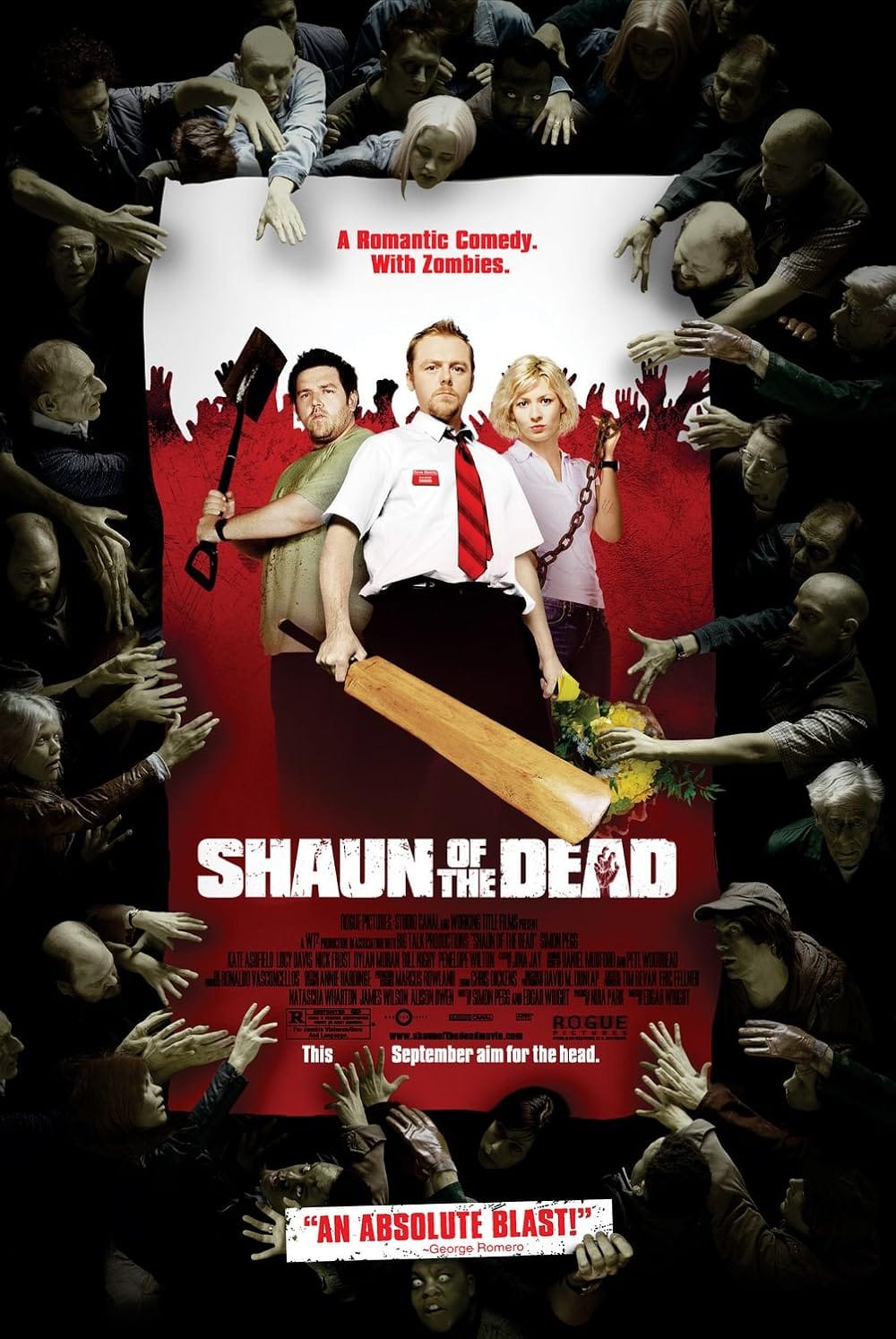
Shaun of the Dead (2004)

**Spoilers below**
I know Halloween is over, but I have a backlog of zombie movies I watched that I haven’t posted about. So, the parade of undead continues with Shaun of the Dead. This 2004 movie is widely regarded as a staple of the subgenre as it riffs on the films that came before it. Despite being a comedy, something about this movie got under my skin. I couldn’t begin to guess what it was, but it left me feeling a little unnerved. The closest I can come to an explanation is that the deliberate comedic beats of the movie juxtaposed against dread and death threw the horror into sharp relief. Normally I love a goofy horror movie, but I also don’t normally watch zombie movies so maybe this an exception?
Regardless, this movie did have my favorite kind of zombies: the slow ones. It’s significantly harder to feel threatened when the monsters trying to eat you move at 0.2 miles per hour and are easily dodged. Unless one sneaks up on you or you become outnumbered and overwhelmed, it doesn’t seem too hard to stay alive. As someone who is relatively new to thinking about zombies, it seems obvious to me that the slow ones would be preferable to survival. However, people who are much more versed in zombie-ism have put a lot of thought into this. I found a great YouTube video that breaks down why we should be afraid of slow zombies. I found some of the assumptions that underpin the model explored in the video flawed, but it was still fun to watch and think about. Plus, the video showcases published academic articles on zombie outbreak modeling that can be applied to real-world phenomena and has a great breakdown of the SIR (Susceptible, Infected, and Removed) model that is a key foundation of epidemiological computation. Definitely go check it out.
Since zombies have been depicted as both fast and slow, I’ve been thinking about the factors that would contribute to the speed and coordination of their movements. I admittedly have not done an exhaustive review of all zombie movies, but the general trend I’ve observed is that fast zombies aren’t really zombies at all. In movies like World War Z, Zombieland, and 28 Days Later the dead aren’t coming back to life; rather regular people are infected with a virus that causes extreme aggression and loss of higher thought. I’ve been putting off watching these movies for exactly that reason – a neural virus that infects living people and spreads rapidly is much more likely to happen in real life than reanimation of the dead (see my previous post on rabies). That these infected are capable of moving quickly and agilely makes perfect sense to me as they would have the same physical abilities as before they became infected.
That’s fairly intuitive and, frankly, uninteresting. So, what about the dead people, the real zombies? I think there are a few key factors that would influence their mobility.
Effects of reanimation
Human movement is enabled by muscle contractions that are driven by the brain. When neurons in the brain fire they release a neurotransmitter (acetylcholine) which stimulates the muscle fibers to contract. The physical abilities of zombies will be determined by how effectively their brain can release these signals.
Now, zombies are typically depicted as mindless monsters that are driven by instinct rather than deliberate thought. This suggests to me that zombies achieve motion through involuntary movement, such as a series of reflexes. There is a condition, hyperreflexia, that is characterized by an overactive reflex response and can be caused by damage to nerve cells. As zombies are classically depicted with low brain function, I don’t think this kind of reflexive signaling that results in slow, uncoordinated motion to serve basic functions (eating and spreading disease) is particularly far-fetched.
State of the corpse
There’s not a lot to say here because it’s fairly obvious that how well-preserved or uninjured the zombie is will determine their ability to get around. A zombie that died years ago and had to claw their way out of the grave will probably be more impaired than a person who was freshly bitten and otherwise healthy. If the musculature and skeletal structure of the zombie have decayed or been damaged, the zombie simply won’t move well. Of course, this will also be compounded by the other factors described in this post.
Decomposition
This is really an extension of the state of the corpse because zombies are, after all, dead people and dead people decay. So, what happens when you die?
First, the heart stops beating and blood and oxygen stop circulating throughout the body. Cells are unable to perform their functions leading to muscle relaxation followed by rigor mortis. Rigor mortis usually begins three hours after death and is gone by 72 hours post-mortem. The Australian Museum has a great summary of rigor mortis if you’re interested in learning more. Because the cells have all died, the body becomes susceptible to consumption by insects, bacteria, and fungi, leading to decomposition. Once again, I recommend checking out the Australian Museum for their breakdown (they have a time lapsed video of a pig decomposing!) But to summarize, decomposition is characterized by 5 stages.
1. Initial Decay: Initial Decay occurs 0-3 days after death and is when bacteria within the body begins to digest the dead tissue. This causes the organs to begin leaking their own digestive enzymes. Additionally, flies will be attracted to the body and begin to lay eggs. The eggs will hatch within 24 hours and the maggots take 2-3 weeks to mature on average.
2. Putrefaction: This stage occurs from 4-10 days after death. During putrefaction the growth of bacteria and release of bodily fluids causes the body to bloat. Additional insects, such as beetles and wasps, become attracted to the body during this time.
3. Black Putrefaction: After 10 to 20 days, the bloated body will collapse and the exposed parts of the body will be black, hence the name. Insects will continue to feed on the dead tissue.
4. Butyric Fermentation: Between 20 and 50 days after death, any remaining flesh will be removed and the body will dry out. This is also when fungi begins to colonize the body as it ferments. The insect population will reduce to beetles as the soft organic material disappears.
5. Dry Decay: The body has now dried out and will continue to decay slowly over 50-365 days. During this time, hair will disappear and only the bones will be left.
The decay of human bodies under various conditions has been extensively studies by the Forensic Anthropology Center, better known as The Body Farm, at the University of Tennessee Knoxville. Between their findings and my assumptions, there’s no reason to think that zombies would be exempt from the decomposition process.
It’s gross, but to me, reassuring. Given enough time, it stands to reason that humanity could outlive the zombie apocalypse simply by waiting them out, provided new infections are also declining. Between decomposition and a fundamental lack of mobility, the zombie apocalypse doesn’t seem so apocalyptic.