Should I be Worried about Fungus Eating my Brain?

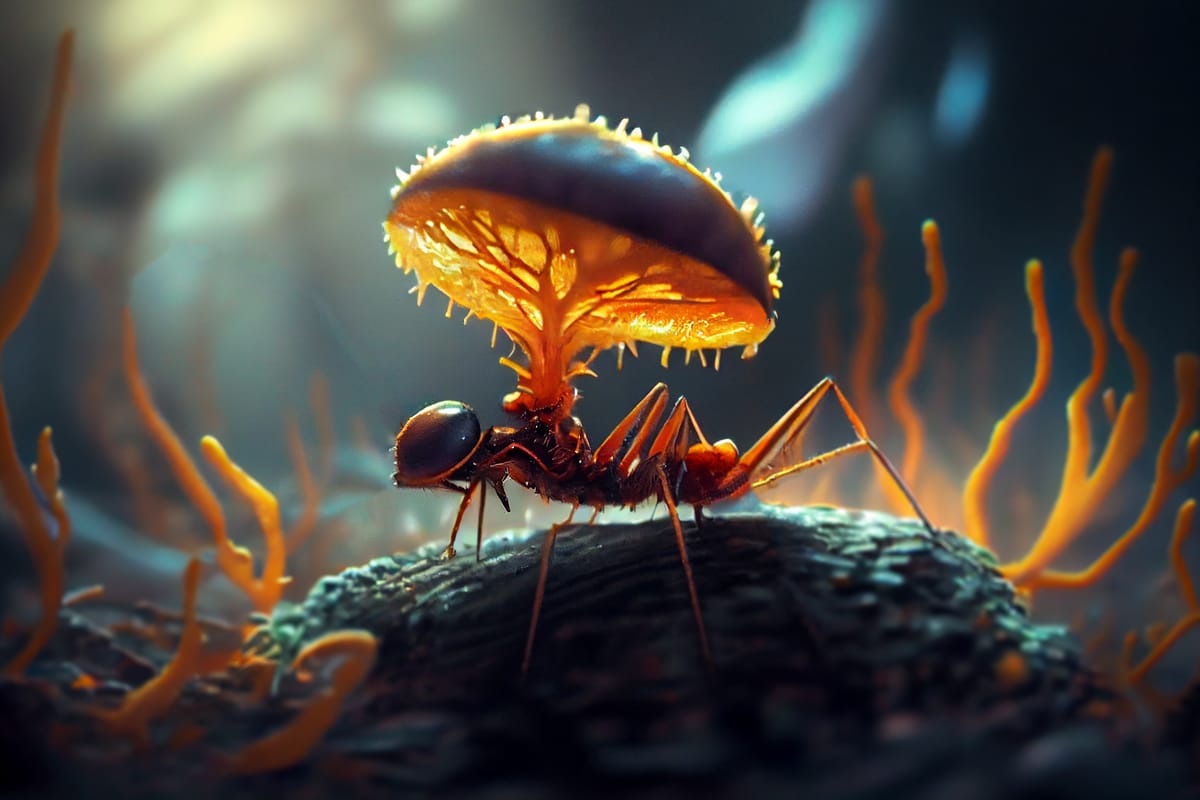
How likely is a cordyceps pandemic as depicted in The Last of Us?
***Spoilers for The Last of Us on HBO Max***
I hate zombies, and when I say hate I mean really hate. Something about undead cannibals overrunning the known world elicits a visceral repulsion in me. A primal disturbance that runs deep and unyielding. I can’t explain it but a quick google search tells me I probably have kinemortophobia, a poetic word that belies its meaning. Derived from the Greek and Latin roots “kine” and “morto” meaning “to move” and “dead”, respectively, kinemortophobia is the fear of zombies. I think it’s quite reasonable to be afraid of the moving dead. So, when my husband, an avid video gamer, informed me that HBO was adapting The Last of Us, a game depicting a zombie post-apocalypse, to say I was less than enthusiastic would be an understatement.
“But they’re not zombies,” he tells me, “They haven’t died and come back to life, they’ve just been infected with a fungus that takes over their brains.”
His assurances were not comforting. Despite my avoidance of all things zombie, logically I know that corpses cannot rise from the earth in search of human flesh. No, what makes my blood run cold when debating the likelihood of a zombie apocalypse is a much more probable scenario: a highly transmissible neurological pathogen that causes extreme violence in humans.
This is exactly the world that The Last of Us has built. Against my better judgement, I have joined the millions of people tuning into HBO every Sunday night to watch Pedro Pascal and Bella Ramsey struggle through a post-apocalyptic wasteland inhabited by “infected”. The premise of The Last of Us is simple; a fungus of unknown origin made the leap into humans, infecting their brains and turning them into mindless aggressive monsters that spread the infection through bites. Based on the acclaimed video game created by Neil Druckmann, The Last of Us tells a rich character-driven story about the importance of love set upon a backdrop of mycelium-induced suffering.
This isn’t meant to be a review of The Last of Us, though I am enjoying it despite being riddled with anxiety every episode. Rather, the great joy of watching pandemic media, as someone who studies infectious diseases, is critiquing the science within them and forming opinions about the plausibility of what’s on screen. By choosing a real-life fungus that currently does not infect humans (but could someday?), The Last of Us injects a dose of frightening realism into the zombie genre.
The first episode of The Last of Us opens with a vignette of two epidemiologists on a talk show in 1968. The host, played by Josh Brener, addresses the first epidemiologist, Dr. Schoenheiss, played by Christopher Heyerdahl, and asks, “And that’s your biggest worry?”, referring to viruses. Dr. Schoenheiss replies that yes, viruses pose a significant pandemic threat, particularly respiratory viruses, and explains that due to the availability of commercial air travel, “a new virus in Madagascar, say, could be in Chicago in a matter of weeks. And we end up with a global pandemic.” The host next turns to the second epidemiologist, Dr. Neumann, played by John Hannah, who rebuts that viruses do not worry him as, “Mankind has been at war with the virus from the start.” and that, “…in the end, we always win.”
[Note, this is ironic since 1968 was the year of the 3rd influenza pandemic in the 20th century1.]
It’s not viruses or bacteria that keep Dr. Neumann up at night; it’s fungi, the declaration of which elicits laughter from the studio audience. According to Dr. Neumann, fungi do not make us sick, they “alter our very minds.” Citing Psilocybe cubensis, more commonly known as magic mushrooms, as an example. “…there are fungi who seek not to kill…but to control.” Dr. Neumann says, as the audience laughter dies. Such a fungus infects ants, taking over its mind and directing its behavior. Over time, Dr. Neumann tells us, the fungus feeds on the ant and begins to replace the ant’s tissue with its own, preventing decomposition through antibiotic properties. It’s at this point that Dr. Schoenheiss interjects that fungi cannot inhabit hosts with an internal temperature over 94°F, such as humans. To which Dr. Neumann asks, “But what if that were to change? What if…for instance, the world were to get slightly warmer?” All it would take is one gene to mutate, he warns, and the adapted fungi “could become capable of burrowing into our brains.” with one goal, to spread the infection to every last human. If that were to happen, he states matter-of-factly, “We lose.” The studio audience is now silent, all humor at the idea of a fungal pandemic gone.
This is, in my opinion, the greatest strength of The Last of Us. The future painted by Dr. Neumann in which we are overtaken by a fungal outbreak feels like a real possibility, and, in the universe of the show, does come to fruition in 2003. I am not the first person to ask if such a scenario is possible; several articles across multiple outlets have been published in response to this question2-5. However, The Last of Us weaves such a rich tapestry of sci-fi that I can’t help but to dissect its lore, and to do so its premise must first be explored.
The fungus described by Dr. Neumann, and that later makes its way into humans, is a real pathogen know as Ophiocordyceps unilateralis, or more commonly, cordyceps. Cordyceps is a general name that encompasses many complex species of parasitic fungi that colonize ants found in tropical forests6. The existence of cordyceps can be dated back 100 million years ago7 and is one of the most studied entomopathogenic fungi8 (entomo being derived from the Greek entomon, meaning insect).
The course of cordyceps infection in ants is both a bewitching evolutionary ballet and a horrifying example of pathogenesis. Ants are exposed to cordyceps in their native environment where the spores surpass the ants’ exoskeleton to begin colonization of the insects. Once a large enough fungal colony has formed, cordyceps makes its way into the ants’ central nervous system (CNS); this is known as the infection stage6,9,10. Once the CNS has been invaded, cordyceps compels the ants to climb up into the foliage and latch onto a leaf or other vegetation in a process known as the “death-grip”8. During the death-grip stage, cordyceps forms a cooperative network that forces the ants’ mandibles open, locking the ant in place after it has died8,11. A stalk, or hypha, then sprouts out of the ants’ head from which new spores are released to infect new hosts on the forest floor8.
This masterful manipulation of the ant is essential to cordyceps replication and spread. Cordyceps reproduction relies on sprouting hyphae and spore release from the head, invariably killing infected ants. Because ants quickly dispose of dead mates from the nest12, effective transmission must occur in an environment that allows enough time for these critical steps. The way in which cordyceps bends the host to its will in order to further its survival and spread demonstrates the unsettling adaptation of cordyceps to ant behavior13. The compulsion to engage in behaviors that serve no purpose other than to facilitate cordyceps reproduction has given rise to the “zombie ant” colloquialism.
To return to the cold open of episode one, Dr. Neumann is distressingly accurate in his description of the control cordyceps exerts over ants. In addition to directing ant behavior, cordyceps does invade the ant body, making up ~40% of the ants’ biomass14. Furthermore, in the 1-2 weeks it takes for the hypha to sprout and germinate6, cordyceps prevents consumption of the nutrient-rich ant corpse by bacteria through the secretion of antibiotic compounds called naphthoquinones15,16.
So, how accurate is his prediction that with the right mutations cordyceps could spillover into humans, ending the world as we know it?
Well, for starters, cordyceps doesn’t infect the brain of ants. Visualization of cordyceps within ants has shown the fungus concentrates within the mandibles and other musculature throughout the body but leaves the brain intact14. Consistent with this, zombie ants exhibit erratic movement and convulsions17. So, while I don’t relish the idea of staggering about in search of a tree to lock my jaw around while I wait for a stalk to sprout out of my head, if human cordyceps infection mirrored that of ants, brain invasion would be avoided.
Next, cordyceps just doesn’t infect humans. Dr. Schoenheiss is correct that our internal temperature is too warm. Cordyceps grows best at a temperature of 20-30°C (68-86°F)18, while the average internal temperature of humans is 37°C, or 98.6°F, a biologically significant difference of over 10°F. Mycologists have hypothesized that climate change could promote adaptation of fungi to warmer temperatures, but this process would be very gradual and has not yet been proven2. Furthermore, Professor David Hughes from Pennsylvania State University, an expert on food security and fungi who consulted on The Last of Us game, believes that while cordyceps crossing over into humans isn’t impossible, mind controlling us is highly unlikely3. This sentiment is shared by parasitic fungi expert Dr. Charissa de Bekker at Utrecht University in the Netherlands, who says cordyceps won’t have the “tools to go and manipulate our brains.”3 This makes sense as obligate parasites, such as cordyceps, evolve alongside their hosts and therefore have a limited range of species they can infect3,19. Consider the way cordyceps has evolved to direct their hosts into foliage rather than nests in response ants’ propensity to remove dead nest-mates.
From this it seems a cordyceps pandemic just isn’t that likely. Though The Last of Us is convincing in its depiction of a fungal post-apocalypse, the paranoia I feel while watching is a product of exceptional storytelling, not science.
References
1. Kilbourne ED. Influenza pandemics of the 20th century. Emerg Infect Dis. 2006;12(1):9-14.
2. Puckett-Pope L. How The Last of Us Made Its Zombie Fungus So Much More Real (and Terrifying). Hearst Digital Media. ELLE Web site. https://www.elle.com/culture/movies-tv/a42535471/the-last-of-us-cordyceps-fungus-infection-explained/. Published 2023. Updated 2/5/2023. Accessed.
3. Hart R. ‘The Last Of Us’ Zombie Infection Is Real—Here’s What Scientists Say About The Threat To Humans. Forbes. Forbes Web site. https://www.forbes.com/sites/roberthart/2023/01/16/the-last-of-us-zombie-infection-is-real-heres-what-scientists-say-about-the-threat-to-humans/?sh=166ad2e62a6e. Published 2023. Updated 1/16/2023. Accessed.
4. Heyward G. The zombie fungus from 'The Last Of Us' is real — but not nearly as deadly. NPR. NPR Web site. https://www.npr.org/2023/01/30/1151868673/the-last-of-us-cordyceps-zombie-fungus-real. Published 2023. Updated 1/30/2023. Accessed.
5. Mikhail A. Elon Musk’s new favorite show ‘The Last of Us’ sparks fear of a real-world fungal pandemic. This fungus expert says never say never. Fortune Media. Fortune Web site. https://fortune.com/well/2023/02/03/the-last-of-us-cordyceps-real-world-fungal-pandemic/. Published 2023. Updated 2/3/2023. Accessed.
6. Andersen SB, Gerritsma S, Yusah KM, et al. The life of a dead ant: the expression of an adaptive extended phenotype. Am Nat. 2009;174(3):424-433.
7. Sung GH, Poinar GO, Jr., Spatafora JW. The oldest fossil evidence of animal parasitism by fungi supports a Cretaceous diversification of fungal-arthropod symbioses. Mol Phylogenet Evol. 2008;49(2):495-502.
8. Mangold CA, Ishler MJ, Loreto RG, Hazen ML, Hughes DP. Zombie ant death grip due to hypercontracted mandibular muscles. J Exp Biol. 2019;222(Pt 14).
9. Mongkolsamrit S, Kobmoo N, Tasanathai K, et al. Life cycle, host range and temporal variation of Ophiocordyceps unilateralis/Hirsutella formicarum on Formicine ants. J Invertebr Pathol. 2012;111(3):217-224.
10. Pontoppidan MB, Himaman W, Hywel-Jones NL, Boomsma JJ, Hughes DP. Graveyards on the move: the spatio-temporal distribution of dead ophiocordyceps-infected ants. PLoS One. 2009;4(3):e4835.
11. de Bekker C, Quevillon LE, Smith PB, et al. Species-specific ant brain manipulation by a specialized fungal parasite. BMC Evol Biol. 2014;14:166.
12. Hölldobler B, Wilson EO. The ants. Harvard University Press; 1990.
13. Loreto RG, Elliot SL, Freitas ML, Pereira TM, Hughes DP. Long-term disease dynamics for a specialized parasite of ant societies: a field study. PLoS One. 2014;9(8):e103516.
14. Fredericksen MA, Zhang Y, Hazen ML, et al. Three-dimensional visualization and a deep-learning model reveal complex fungal parasite networks in behaviorally manipulated ants. Proc Natl Acad Sci U S A. 2017;114(47):12590-12595.
15. Amnuaykanjanasin A, Panchanawaporn S, Chutrakul C, Tanticharoen M. Genes differentially expressed under naphthoquinone-producing conditions in the entomopathogenic fungus Ophiocordyceps unilateralis. Can J Microbiol. 2011;57(8):680-692.
16. Wichadakul D, Kobmoo N, Ingsriswang S, et al. Insights from the genome of Ophiocordyceps polyrhachis-furcata to pathogenicity and host specificity in insect fungi. BMC Genomics. 2015;16:881.
17. Hughes DP, Andersen SB, Hywel-Jones NL, Himaman W, Billen J, Boomsma JJ. Behavioral mechanisms and morphological symptoms of zombie ants dying from fungal infection. BMC Ecol. 2011;11:13.
18. Kumlien A, Carlson S. Ophiocordyceps unilateralis. BioWeb - University of Wisconsin La Crosse. http://bioweb.uwlax.edu/BIO203/f2013/kumlien_aaro/habitat.htm. Published 2006. Accessed 2/14/2023, 2023.
19. Lin WJ, Lee YI, Liu SL, Lin CC, Chung TY, Chou JY. Evaluating the tradeoffs of a generalist parasitoid fungus, Ophiocordyceps unilateralis, on different sympatric ant hosts. Sci Rep. 2020;10(1):6428.