Zombieland (2009): A Love Letter to Prions

**Spoilers below**
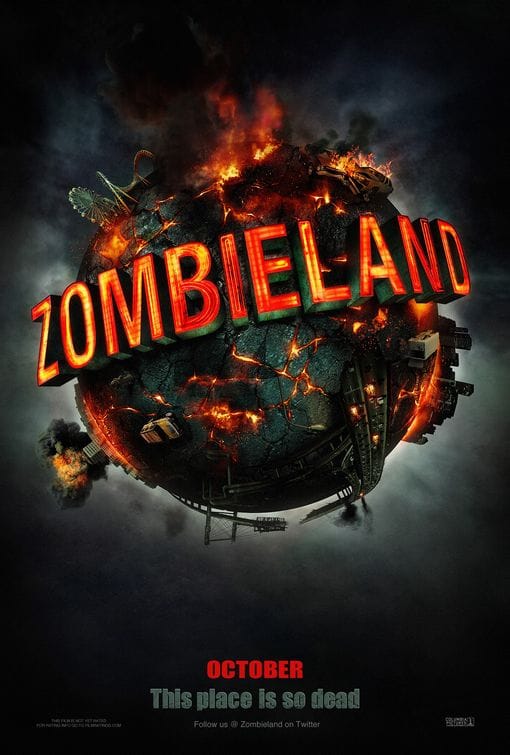
This will be the last zombie movie review I post (at least for now). This movie was my personal Everest. I first saw Zombieland in 2010 at a friend’s house and I hated it. I didn’t even watch the whole thing, just the first 45 minutes or so. Didn’t matter. The image of the little girl zombies in their Disney princess dresses burned itself into my brain and caused irreparable psychological damage. Then in college, I gave it another try with my then-boyfriend, now-husband. He doesn’t believe we watched it together, but I know we did because how else could I remember the Bill Murray bit and the entire end sequence at the theme park? Same result. I spent most of the movie with my fingers over my eyes, preemptively dreading the nightmares that followed. Why did it scare me so much? Beyond my general zombie aversion, I think it’s because it’s a gross movie. The effects are really good, so the zombies are ragged and they’re constantly vomiting out black goo right before trying to chase down and eat the protagonists. Plus they’re fast, and as a person who hates to run, there’s just no earthly way I’d survive.
Despite having seen snippets of it before, I had forgotten what caused the zombie outbreak. To quote Jesse Eisenberg’s character, Columbus, “Remember mad cow disease? Well, mad cow became mad person became mad zombie. It’s a fast-acting virus that left you with a swollen brain, a raging fever. That made you hateful, violent, and gave you a really, really bad case of the munchies.” This bit of exposition could not have made me happier because prions cause mad cow disease and prions are fascinating.
The claim that “It’s a fast-acting virus” is patently false as prions are their own distinct disease-causing agent.
|
Virus |
Prion |
|
An infectious
particle made up of genetic material (DNA or RNA) and proteins. |
A misfolded
protein. |
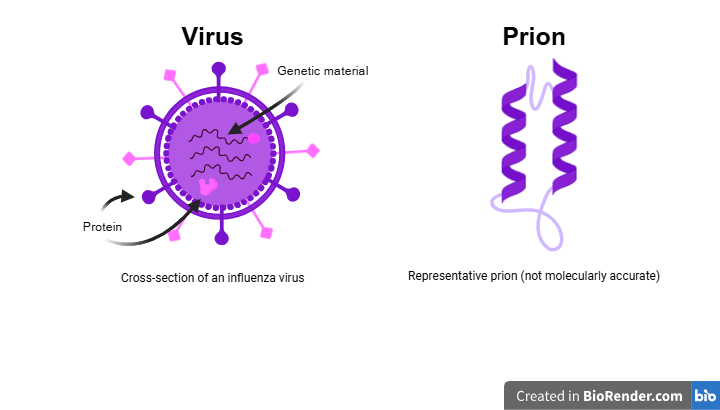
Prion disease (spongiform encephalopathy) is caused by proteins that have been improperly folded. Once they lose their correct shape, they cause the proteins around them to also misfold and aggregate, leading to holes in the brain tissue giving it a sponge-like appearance (hence the spongiform in the scientific name). The name prion is itself an amalgamation of “proteinaceous infectious particle”. Fragments of prions will break off and move to other parts of the brain, leading the disease to spread throughout the entire central nervous system (CNS).
Prion disease in humans is known as Creutzfeldt-Jakob disease (CJD). CJD is rare but fatal, and there are no treatments or vaccines available. CJD symptoms present as neurologic and include memory loss, impaired cognition, personality changes, vision impairment, insomnia, loss of coordination and balance, trouble speaking, sudden/jerky movements, and trouble swallowing. Most people with CJD die within one year of symptom onset, though not of the disease itself but due to medical issues associated with the disease. There are four types of CJD that affect humans:
1. Sporadic CJD: The most common type of CJD that occurs “sporadically” with no apparent cause. This type occurs most often in adults between 45 and 75 years old.
2. Variant CJD (vCJD): Primarily caused by consuming meat from a cow with bovine spongiform encephalopathy (BSE), more commonly known as “mad cow disease”. vCJD can have very long incubation periods of more than 10 years before symptoms appear. We’ll come back to this type.
3. Inherited CJD: This is a very rare genetic condition where a person inherits a gene carrying a mutation that causes prions to form. Symptoms of inherited CJD most often develop when people are in their early 50s.
4. Iatrogenic CDJ: Iatrogenic CJD is caused when CJD is accidentally spread through medical or surgical treatments.
Prion disease is also found in free-range deer and elk and is known as chronic wasting disease (CWD) in these populations. I’m not going to dwell on CWD, but it is interesting and you can learn more here. However, I will give a general PSA that while there has never been a case of humans developing prion disease from consuming meat from an animal with CWD, if you see an animal exhibiting symptoms please report it to your local conservation authority and always take precautions when handling, processing, and eating wild game meat.
Okay, on to mad cow disease. One of my favorite podcasts, Maintenance Phase, has a great two-parter* on the history of BSE, and you get some Oprah content. The TLDR on mad cow is that most cases (78%) have been reported in the U.K with a smattering of cases across the U.S., Canada, Japan, Saudi Arabia, and various other European countries. Several very stringent regulations have been implemented in many countries to prevent potentially infected tissues from entering the human food supply. These public health measures have been very effective, so you can eat your steak or burgers without fear.
But let’s pretend these measures didn’t work and some poor soul ate a burger contaminated with BSE and contracted vCJD. We’ve already established it’s not a virus, and it’s also not particularly fast-acting. To get it, you’d have to pull an Uno reverse and eat the zombie instead of letting the zombie eat you. I’m willing to be generous and say some of the symptoms of vCJD (memory loss, impaired cognition, trouble speaking, and personality changes) could manifest in zombie-like behavior but there was no real loss of vision, coordination or balance, and definitely not the ability to swallow in the infected in Zombieland.
Despite my resounding conviction that prion disease does not and will not turn people into ravenous, animalistic monsters I love that the screenwriters decided to use a real disease as the premise for this movie. Is it an unequivocally inaccurate depiction of prion disease? No question. But 1) it gave me an opportunity to talk about prions, so yay, and 2) that’s what science fiction is for. To take real phenomena and stretch their limits into the fantastical.
With my journey into zombie movies concluded (for now) I’m planning on doing one more post to wrap up my thoughts on this particular flavor of apocalypse. I’m still deciding what form that’s going to take, so stay tuned!
*Episode titles are Oprah v. Beef Part 1: The Rise of “Veggie Libel” and Oprah v. Beef Part 2: Apocalypse Cow.